
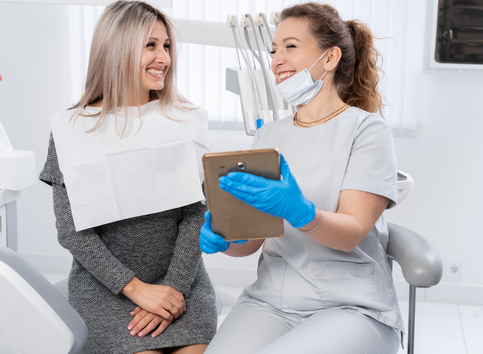
A first dental visit with a new practice sets the baseline for everything that follows: your records, your X-rays and the treatment plan your dentist will work from for years. A little preparation makes the appointment shorter, gives the dentist better information and takes most of the uncertainty out of the chair. Below is what to do before you go, what happens during the visit and what to expect afterward.
Before the Appointment
Check with your insurance provider that the practice is in network and find out what preventive care your plan covers. Many plans cover two exams and cleanings per year, while X-rays and other diagnostic services often follow separate frequency limits.
Ask the office whether they can send intake forms by email. Filling them in at home saves 15 to 20 minutes in the waiting room and gives you time to look up details you would not remember on the spot. Prepare a short list with:
- medications and supplements you take, with dosages
- allergies, especially to latex, local anesthetics or antibiotics
- medical conditions such as diabetes, heart problems or pregnancy
- the date of your last cleaning and any recent X-rays; ask your previous dentist to forward them, which can spare you a new set
If you have had a bad experience at the dentist in the past, write that down too. Dental teams see anxious patients every day, and telling them at the start changes how they pace the visit.
On the Day
Brush and floss before you leave, but there is no point scrubbing harder than usual to make up for months of skipped flossing. The hygienist measures the real condition of your gums, and aggressive last-minute brushing only makes them sore.
Arrive 10 to 15 minutes early with your ID, insurance card and list. Eat a light meal beforehand, since an exam and cleaning can take an hour or more and you may be numb afterward if any treatment is done the same day. If you tend to get nervous, go easy on coffee that morning.
What Happens in the Treatment Room
Before you sit down, the room has already been prepared for you. The chair, light handles and work surfaces are wiped with hospital-grade disinfectant between patients, and some are covered with disposable barrier film. Instruments arrive in sealed sterilization pouches that have been through an autoclave, a pressurized steam cycle that kills bacteria, viruses and spores. The assistant will often open the pouch in front of you.
The dentist and assistant put on a fresh pair of gloves and a face mask for every patient, together with protective eyewear. Gloves are changed whenever they touch something outside the treatment area, and masks protect both patient and staff from the fine spray created by cleaning instruments. This is standard infection control in US practices, and offices compare suppliers carefully to stock the best dental gloves and masks for hours of daily wear. If you have a latex allergy, say so: most practices already use nitrile, but the team will make sure nothing in the room contains latex.
A typical first visit includes:
- X-rays, usually bitewings to check between the back teeth, plus a panoramic image if none is on file
- a full exam of teeth, fillings and crowns, with each tooth charted
- gum measurements, where the hygienist uses a small probe to check the pocket depth around each tooth; readings of 1 to 3 millimeters are generally healthy
- an oral cancer screening of the tongue, cheeks and throat
- a cleaning to remove tartar, followed by polishing and sometimes fluoride
What If You Feel Anxious in the Chair?
Agree on a stop signal before anything starts, usually raising your left hand. Knowing you can pause at any moment lowers tension more than anything else. Headphones help with the sound of the scaler, and slow breathing through the nose keeps your jaw relaxed. If some areas are sensitive, ask for a numbing gel before the cleaning.
After the Visit
The dentist will go through the X-rays and findings and propose a treatment plan if anything needs attention. Ask for the plan in writing, with procedure codes and estimated costs, so you can check it against your insurance before booking, and ask which items are urgent and which can wait.
Gums can feel slightly tender for a day after a thorough cleaning. A warm salt water rinse helps, and it is worth skipping very hot or spicy food for the rest of the day. Book your next cleaning before you leave, since six-month slots at busy practices fill up quickly.
 Nolissa Kryndalla has opinions about mental health resources. Informed ones, backed by real experience — but opinions nonetheless, and they doesn't try to disguise them as neutral observation. They thinks a lot of what gets written about Mental Health Resources, Fitness Tips and Routines, Workout Techniques and Guides is either too cautious to be useful or too confident to be credible, and they's work tends to sit deliberately in the space between those two failure modes.
Reading Nolissa's pieces, you get the sense of someone who has thought about this stuff seriously and arrived at actual conclusions — not just collected a range of perspectives and declined to pick one. That can be uncomfortable when they lands on something you disagree with. It's also why the writing is worth engaging with. Nolissa isn't interested in telling people what they want to hear. They is interested in telling them what they actually thinks, with enough reasoning behind it that you can push back if you want to. That kind of intellectual honesty is rarer than it should be.
What Nolissa is best at is the moment when a familiar topic reveals something unexpected — when the conventional wisdom turns out to be slightly off, or when a small shift in framing changes everything. They finds those moments consistently, which is why they's work tends to generate real discussion rather than just passive agreement.
Nolissa Kryndalla has opinions about mental health resources. Informed ones, backed by real experience — but opinions nonetheless, and they doesn't try to disguise them as neutral observation. They thinks a lot of what gets written about Mental Health Resources, Fitness Tips and Routines, Workout Techniques and Guides is either too cautious to be useful or too confident to be credible, and they's work tends to sit deliberately in the space between those two failure modes.
Reading Nolissa's pieces, you get the sense of someone who has thought about this stuff seriously and arrived at actual conclusions — not just collected a range of perspectives and declined to pick one. That can be uncomfortable when they lands on something you disagree with. It's also why the writing is worth engaging with. Nolissa isn't interested in telling people what they want to hear. They is interested in telling them what they actually thinks, with enough reasoning behind it that you can push back if you want to. That kind of intellectual honesty is rarer than it should be.
What Nolissa is best at is the moment when a familiar topic reveals something unexpected — when the conventional wisdom turns out to be slightly off, or when a small shift in framing changes everything. They finds those moments consistently, which is why they's work tends to generate real discussion rather than just passive agreement.